Pilot Educational-Research Center for Data Analysis and Artificial Intelligence in Sustainable Agriculture
A National Initiative for Applied Learning, Innovation, and Regional Cooperation in the Mediterranean
This proposal presents the establishment of a pilot educational-research center in Morocco dedicated to training students and young researchers in data analysis, artificial intelligence (AI), and applied research methods with a focus on sustainable agriculture and renewable energy systems. The center will serve as a national model for integrating technology, education, and sustainability in one platform, while also fostering collaboration with neighboring Mediterranean countries. Its mission is to prepare the next generation of skilled professionals capable of applying AI tools to address challenges such as climate change, food security, and resource efficiency.
The Mediterranean region faces growing pressures on water, soil, and energy resources due to rapid population growth and changing climatic conditions. At the same time, agriculture remains a central pillar of both the economy and community livelihoods. To meet these challenges, the agricultural sector must evolve into a more data-driven and technologically advanced system. Artificial intelligence offers powerful tools for improving productivity, monitoring environmental conditions, and optimizing resource use. However, many regions still lack the infrastructure and expertise needed to apply these technologies effectively. The proposed center aims to bridge this gap by creating a space where students, researchers, and practitioners can learn, experiment, and innovate using real-world data and AI tools.
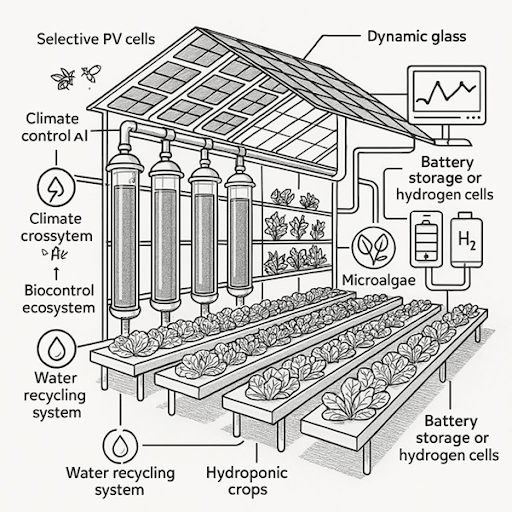
The educational-research center will be built around a living laboratory — an integrated agricultural system that combines solar energy generation, hydroponic cultivation, microalgae production, and biogas recovery. This system, known as the Integrated Agri-Solar Greenhouse, represents a closed-loop model in which energy, water, and biological resources are continuously reused. Solar panels provide clean electricity; hydroponic systems grow crops with minimal water; microalgae cultivation utilizes carbon dioxide and nutrients from biogas residues; and the biogas digester converts organic waste into renewable energy and fertilizer. Together, these components form a sustainable micro-ecosystem that can be monitored and optimized through AI-based analysis. The greenhouse will serve both as a teaching facility and a data source, offering students the opportunity to work directly with real-time environmental and operational data.
Within this framework, the center’s educational program will focus on training students in data analytics, AI modeling, and research methodology. Participants will learn to use tools such as Python, TensorFlow, and open-source data platforms to process and interpret data collected from sensors and monitoring systems. They will be guided through the full research cycle — from designing experiments and managing data, to building predictive models and interpreting their implications for agricultural sustainability. The emphasis will be on applied learning, allowing students to work on concrete problems such as optimizing water consumption, forecasting crop yields, or improving energy efficiency within the greenhouse. The approach combines classroom instruction, laboratory work, and hands-on experience with advanced digital tools.
The center will also function as a collaborative research hub linking Moroccan institutions with universities and research centers across the Mediterranean. Partnerships with organizations in Jordan, Cyprus, and other neighboring countries will facilitate the exchange of knowledge, datasets, and expertise. Joint workshops, online seminars, and exchange programs will bring together students, academics, and professionals to collaborate on projects addressing shared environmental and technological challenges. This cooperation will not only enhance scientific capacity but also strengthen cultural and academic ties across the region.
A key component of the initiative will be the development of a digital data and learning platform to support both in-person and remote training. This platform will host open-access datasets from the greenhouse and provide students with a virtual environment to practice data analysis, visualization, and modeling. It will also offer educational resources, recorded lectures, and collaborative spaces for research projects. By combining physical infrastructure with digital connectivity, the center will ensure accessibility to a broader audience, including students from other parts of Morocco and partner institutions abroad.
The expected outcomes of the project include the creation of a fully operational educational-research center equipped with both experimental and digital facilities, the training of a new generation of students proficient in AI and data-driven research, and the development of collaborative studies published jointly with regional partners. Over time, the center will contribute to a stronger innovation ecosystem, supporting Morocco’s transition toward sustainable agriculture and a knowledge-based economy. It will also help position the country as a regional leader in combining digital technologies with green development.
The project is envisioned as a three-year pilot initiative. In the first phase, the focus will be on establishing the greenhouse infrastructure, digital systems, and curriculum development. The second phase will launch the first training programs, data collection, and collaborative projects. The final phase will evaluate outcomes, expand partnerships, and prepare a plan for long-term sustainability and replication in other educational institutions. The budget will cover equipment, computing and sensor systems, staff and research costs, as well as educational materials and student exchanges. All activities will align with national and regional sustainability goals and adhere to the Ministry of Regional Cooperation’s funding and evaluation frameworks.
In conclusion, the proposed Pilot Educational-Research Center for Data Analysis and Artificial Intelligence in Sustainable Agriculture represents a forward-looking investment in education, innovation, and sustainable development in the Mediterranean. By combining hands-on experimentation with digital training, the center will empower young people to use data and AI as tools for solving real-world problems in agriculture and environmental management. It will also foster a culture of research, collaboration, and responsible innovation — essential ingredients for building a resilient and sustainable future for Morocco and the wider region.